Applications
Applications
Divi ships ready-made programs for the main families of near-term quantum workloads. Each is an ordinary QuantumProgram, so it gets parallel execution, every backend, checkpointing, and dry runs for free.
Combinatorial optimisation
- QAOA and Iterative QAOA, which warm-starts deeper circuits from shallower ones, applied to graph problems (MaxCut, max clique, independent set, vertex cover, matching, TSP, vehicle routing) and to general binary optimisation problems with linear constraints. Portfolio problems are included.
- PCE (Pauli Correlation Encoding). Encodes N binary variables into roughly log₂ N qubits, so much larger QUBOs fit on today’s devices.
- Partitioning.
PartitioningProgramEnsemblesplits a large graph or QUBO into sub-problems, using spectral, METIS, Kernighan–Lin, or community decomposition. It solves each sub-problem in parallel with QAOA, PCE, or Iterative QAOA and recombines the partial solutions with beam search. - QUBO characterisation. On Qoro’s cloud, a QUBO can be assessed for QAOA suitability before running, and the assessment suggests initial parameters.
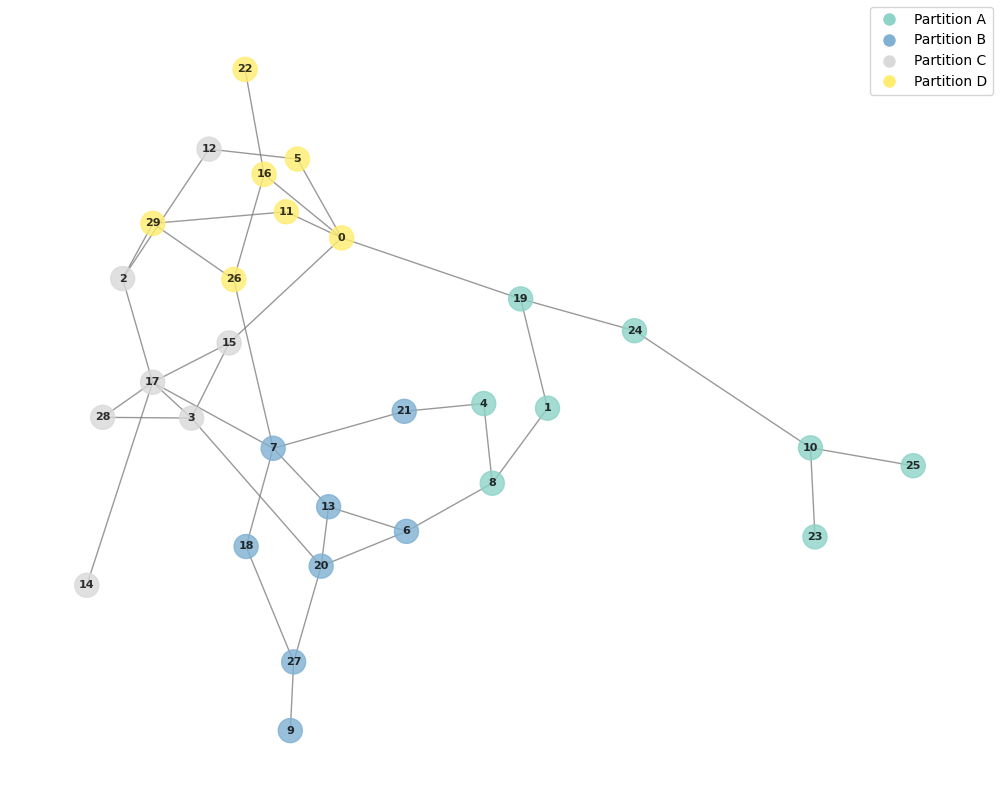
A 30-node graph partitioned into clusters of at most 10 nodes
Chemistry
- VQE on molecular Hamiltonians built with PennyLane or PySCF, with chemistry ansatzes (Hartree–Fock, UCCSD, QCC, LUCJ) and generic layered ansatzes.
- Sweeps.
VQEHyperparameterSweepruns VQE over geometries and ansatzes in parallel, for example to trace a potential-energy curve. - LASSQD. A fragment-based sample-based quantum diagonalisation workflow for larger molecules.
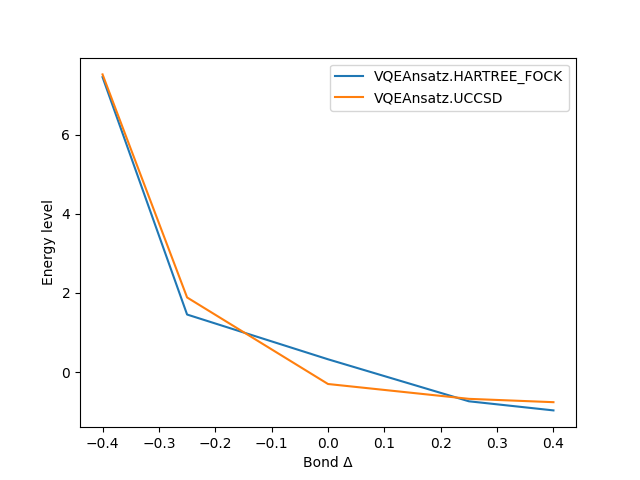
Energy against bond length for several ansatzes from one parallel sweep
Dynamics
- Time evolution under a Hamiltonian using exact Trotterisation or QDrift, and trajectories over many time points run as one ensemble.
Machine learning and custom circuits
- QNN. Variational classifiers with angle and ZZ feature maps.
- CustomVQA. Optimise any parameterised Qiskit or PennyLane circuit with Divi’s execution and optimisers.
Error mitigation
Zero-noise extrapolation (global or local folding, with linear or Richardson extrapolation), QuEPP, and Pauli twirling are implemented as pipeline stages, so they work with any program and any backend.
📖 Tutorials and the full API: divi.readthedocs.io.